
By Zachary Cohen:
Humanity is no stranger to innovation, but artificial intelligence threatens to take away a piece of our agency no machine has ever challenged before. Instead of just gunning for our labor, the modern phenomena might be in the process of changing how we think, and therefore, affecting our moral judgement. The path for AI was paved thousands of years ago, since we began searching for ways to ease the burdens of work in virtually every way imaginable.
Inventions ranging from the wheel to the washing machine were designed to accomplish tasks more efficiently or beyond what our bodies could handle on their own. As the engine of labor mechanized with the First Industrial Revolution in 18th century Great Britain, humanity witnessed a unique and great sacrifice of humanity for productivity. Now, we are presented with an opportunity to take the next step. Many have predicted artificial intelligence to cut labor in a similar manner to the mechanical introduction; however, we fail to see the implications of when we introduce automation into thinking, the most essential tether to preserving our humanity. In embarking on the path to replace our hands, over 250 years later, we have sculpted a tool to replace our minds.
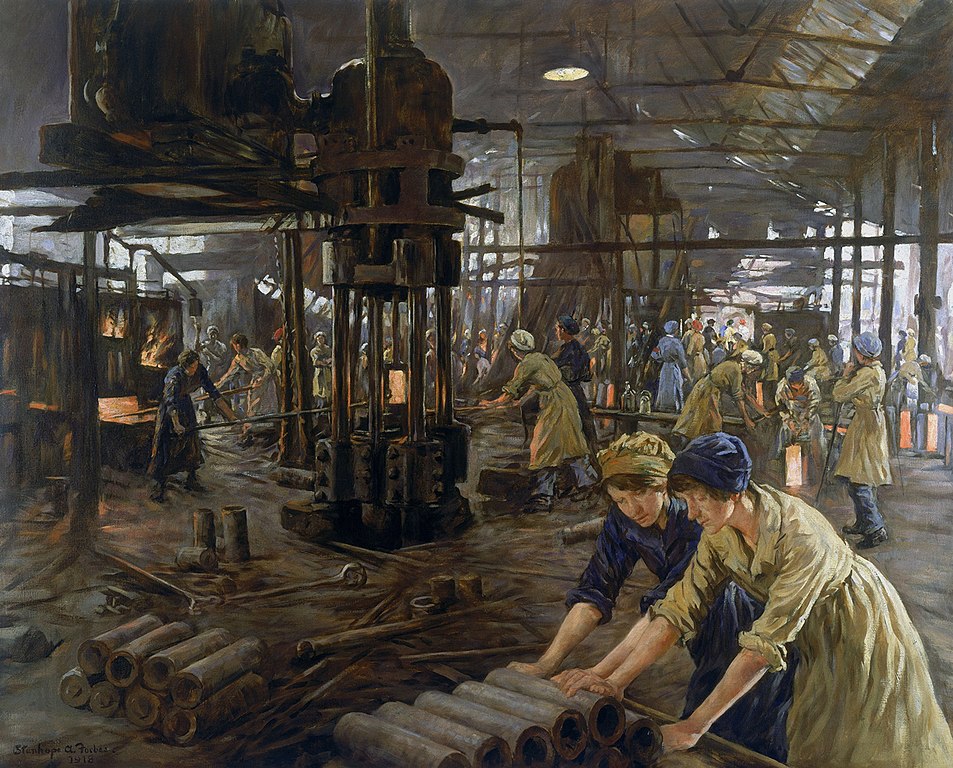
Scenes of industry: innovation’s consequences
“The Munitions Girls” by Stanhope Forbes. Women handling explosives and other weaponry, dedicating safety and labor to the machine of war
Artificial intelligence, specifically the chatbots available for free on the internet, comprise data to supply algorithmic approximations to user input. However, this is not the common expectation of AI. The services utilized on these sites are often treated as if they read and comprehend commands and produce answers. The true disconnect is explained by first an understanding of how rhetoric works among people, and AI’s role as its first non-human wielder.
Rhetoric is the function of language that allows us to persuade and convince, essentially imposing thought on each other. Using speech, rhetoric manipulates the processes of thinking in a unique way that opens the door for danger when misused. If I were to ask you whether or not you prefer chocolate or vanilla ice cream, if you decide to say chocolate, you have taken a definitive stance on that question. After giving your response, if I were to rewind time three seconds, you would answer chocolate again if nothing changed. In a thousand parallel universes with the same conditions, you will always choose chocolate. However, if I tell you before the question that vanilla is a superior flavor, and only idiots like chocolate, you might switch your answer to vanilla. This change could be to conform to my ideology, but on a deeper level, you now have built a slight predisposition to chocolate ice cream that has disrupted your process of thinking, even if minute.
In examining the change from a motionless focus on chocolate to a psychologically-altered state of unpredictability, the power of rhetoric cannot be understated. To bend our minds to the will of others is a curious phenomenon, but where it becomes a unique argument to our agency is when artificial intelligence is introduced. When AI provides an answer to a question that impacts judgement, your decision-making now features a small artificial component. That psychological rupture comes from a source with no ethical understanding or moral compass. The more we rely on AI to bridge gaps we used to cross ourselves, the more we subject our ability to think to algorithmic logic.

Datacenter responsible for supplying the “morality” of artificial intelligence
Image: switch.com (data center operator)
Perhaps the influence of artificial intelligence on our thought appears too small to matter. If society becomes marginally shaped by ChatGPT and its peers, what real change emerges? After all, these engines are constructed from preexisting human-generated information found on the internet. These are valid concerns, yet the danger of a society dependent on artificial thought stems not from its content but from its growing impact on our judgment.
Scottish philosopher David Hume explored the process by which humans should treat decision-making as a product of fact and judgement. In his work, A Treatise of Human Nature (1739), he distinguished the descriptive statement, a claim on what is, and the prescriptive statement, a claim on what “ought to be.” For example, “the people of the Earth are hungry” is a purely descriptive idea based on observation. The relevant prescriptive conclusion would be “the people of Earth ought to be fed,” led by inference. While sometimes seemingly obvious, transitions from descriptive to prescriptive can be complicated. The descriptive statement, “the chocolate ice cream contains nuts” can create many inferences depending on a variety of factors like preference and allergies. The assessment is then dependent on human interpretation to make the call to serve said ice cream. Hume’s Law concluded that the bridge between the descriptive and prescriptive required more than fact and logic.
Through lived experiences, humans develop the empathy and critical thinking skills to understand right and wrong. Hume alleged that a “moral judgement” was required to complete a successful prescription. Artificial intelligence can source ideas from statistics, but without lived experience, it cannot understand the human condition well enough to offer ethical reasoning. When humanity accepts an artificial entry into its decision-making, a piece of our natural moral compass is traded for convenience, weakening both our moral agency and conscience.
When we delegate our judgement to algorithms, it is only a matter of time before we relinquish our ability to judge independently on a noticeable scale. In this day and age it is virtually impossible to avoid artificial intelligence. Provided with the technology to have your thoughts generated for you, remember the advantages of your own mind before maximizing your reliance. It might be worth considering how we treat our AI usage before humanity thinks with em-dashes instead of morals.


Leave a comment